
Data center risks right now
6 critical questions to enable a resilient buildout
A look at the pivotal forces shaping data center construction and ongoing operations—from insurance to energy to geopolitics—for builders, owners, consumers and legislators.
Zurich North America
2026 U.S. Edition
Originally published April 2026
Data centers are rapidly scaling to meet AI-driven demand, creating new challenges across construction, operations and risk management. This report outlines the key factors shaping today’s data center environment—including insurance capacity, severe weather exposure, energy and water constraints, system resilience and evolving regulatory pressures. It highlights why early planning, redundancy and cross-stakeholder collaboration are critical to minimizing downtime, protecting high-value assets and ensuring long-term performance in an increasingly complex and high-stakes digital infrastructure landscape.
Table of Contents
This is not last year’s data center
A Zurich risk engineer steps onto a site the size of a small town: Construction cranes move over a steel skeleton while servers hum inside an enclosed hall next door, connected by a utility bridge. Nearby, an onsite power plant, consisting of natural gas turbines and a battery energy storage system, backs up grid power to reliably feed this AI data center’s enormous appetites.
Millions, even billions of dollars in servers and cooling equipment are packed tight, marching down seemingly endless aisles of what will ultimately comprise a 3-mile-long, 20-building campus with 2,000 megawatts of power: demand comparable to the city of Austin, Texas.
At any given moment, anywhere from 1,500 to 3,000 workers are plying their trade, crossing paths at fast-forward speed. The timeline for this project is 24 months, similar to projects a fraction of its size a year ago.
Meanwhile, for the portion of data halls already commissioned and operating, a small deviation in temperature, humidity or power; a spark from a welder’s torch; a puff of dust or a spring time hailstorm all can carry outsized consequences.
This is the reality of data centers in 2026: Surging, urgent construction backed by jaw-dropping capital investment and marked by new intersections of risk. How these risks are navigated will determine the success of this buildout in the U.S. and beyond and—while it may sound dramatic—influence the course of human and AI progress.
Data center resilience is in everyone’s interest, and building it requires collaboration across all stakeholders. This report covers six pivotal forces in that effort, from construction through early operations, based on insights from Zurich risk engineers, underwriters and claims professionals with deep experience supporting this space.
The data center described is a composite, illustrative example intended to reflect common characteristics of some modern data centers and does not represent any specific site.
The data center boom, by the numbers
~$710 billion
Capital expenditures planned by top hyperscalers in 2026.
~100 gigawatts
New data center capacity projected to be added from 2026 to 2030, equal to about 9 New York Cities at peak demand.
$7 trillion
Projected global data center
investment by 2030.
I. How much insurance is enough?
Navigating capacity challenges
Just five years ago, the average project value of Zurich-insured data centers was around $150 million. Today, it’s $3 billion. As today’s mega sites run into the tens of billions of dollars, capacity has become a significant stress point. Lenders are increasingly involved in financing these projects, and many are seeking insurance to full value.

“Capacity challenges are highly dependent on the size, scope and geographic location of each project,” said Kelly Kinzer, Global Head of Construction and Surety for Zurich. “At the upper end of size, there simply isn’t sufficient insurance capacity in the market to insure these projects to their full value.
“How big of a limitation is this on the ability to satisfy the need for AI data centers? Time will tell. But in the meantime, insurance providers are working closely with customers and brokers to provide solutions as well as education.
“Full-value insurance is often neither necessary nor the most effective risk solution,” Kinzer said. “Many of these campuses are spread across very large footprints, with meaningful distance between individual structures, which naturally reduces the likelihood of a total loss. In those situations, it can be more appropriate and efficient to insure to an Estimated Maximum Loss (EML) rather than a full limit.”
Another important emerging topic is concentration of risk. Insurers, including Zurich, reinsurers and hyperscalers are closely monitoring their risk accumulations. Discipline over geographic concentration and aggregation of exposure is essential to maintain a sustainable and resilient insurance market.
“The market has a strong appetite to support the data center sector,” said Heather Fox, President of U.S. National Accounts at Zurich, “but success depends on early collaboration and effective communication with those involved in financing. These projects require thoughtful site planning, design, engineering-led risk assessment and experienced carriers with broad capabilities. No single uniform insurance solution will fit every project.
“It’s one reason leading providers are developing specialized offerings for data centers.
Specialized insurance features from experienced providers can offer the right protection, especially when customized to the location,” said Tobias Cushing, Zurich U.S. Head of Construction. “Loss concerns with data centers center more on severity than frequency. And with values like this, you want to know the name of the insurance executive you can call about a claim.”
Conversely, carriers need to be disciplined about the risks they underwrite. “At Zurich we work with experienced builders and owners who share our uncompromising commitment to safety with rigorous quality controls,” said U.S. Head of Zurich Resilience Solutions Arooran Sivasubramaniam .

As capital intensity rises with data centers, insurance considerations extend beyond physical assets and construction risk. The financing structures behind today’s data center investments, which may include off-balance sheet special purpose vehicles, may elevate scrutiny of board-level decisions. For directors and officers, the scale of capital investment, growth projections and complex funding models can heighten exposure to shareholder litigation—particularly if stated expectations are not met or disclosures fall short.
“It’s critical for boards to operate within a clear governance framework,” said Nora Hattauer , Head of Financial Lines for Zurich North America. “That means pressure testing return assumptions, understanding downside scenarios and documenting how major investment decisions are made, with input from qualified legal, accounting and technical experts. Those fundamentals can make a meaningful difference in mitigating D&O risk.”
In sum, organizations that approach data center investments with technical rigor, clear oversight and robust communication are better positioned to navigate capacity constraints, protect capital and sustain momentum as this buildout continues.
Capacity challenges are highly dependent on the size, scope and geographic location of each project.
Kelly Kinzer
Global Head of Construction and Surety for Zurich
Ahead of the megaproject curve
Zurich launched Fronted Master Builders Risk in 2025 to help meet rising coverage capacity needs and keep global, multi‑year projects under one structure.
Getting EML right starts with specialized engineering insight
To help with insurability from construction through operations, Zurich Resilience Solutions (ZRS) built a specialized Data Center Risk Advisory practice.
Specialized coverages
for data center needs
In 2026, Zurich launched Data Center Project Guard to close common gaps in traditional Builders Risk coverage, with an option for up to 12 months of property coverage to support phased handovers, plus other tailored coverages.
II. Are we adjusting for new intersections of risk?
Old ways need updating
In 2025, a tornado at a data center site was a leading cause of loss in Zurich Construction’s Builders Risk portfolio. This event reflects a redrawing of the map of data centers, which are moving into the interior of the U.S., where land is more abundant but where severe convective storm risk is elevated. It’s just one way today’s data centers are entering new frontiers.
In 2026, 64% of the data center capacity under construction is outside traditional hubs such as Northern Virginia and in so-called frontier markets, such as West Texas, Tennessee, Wisconsin and Ohio. Projects in these areas may face heightened risk of tornadoes, hail and high winds wreaking havoc on vast roofs, exposed HVAC, cooling towers and energy installations such as solar.
“How you manage to that is a major consideration,” said Jimmy Durkin, Natural Hazards Director for Zurich Resilience Solutions, suggesting hail guards, metal protectors and hail-rated roof assemblies as construction-phase enhancements that can pay operational dividends.
Similarly, weather swings in these states can elevate risks such as leaks and rust-causing condensation. Early leak detection technology is crucial, as is staff well-trained in how to act fast.
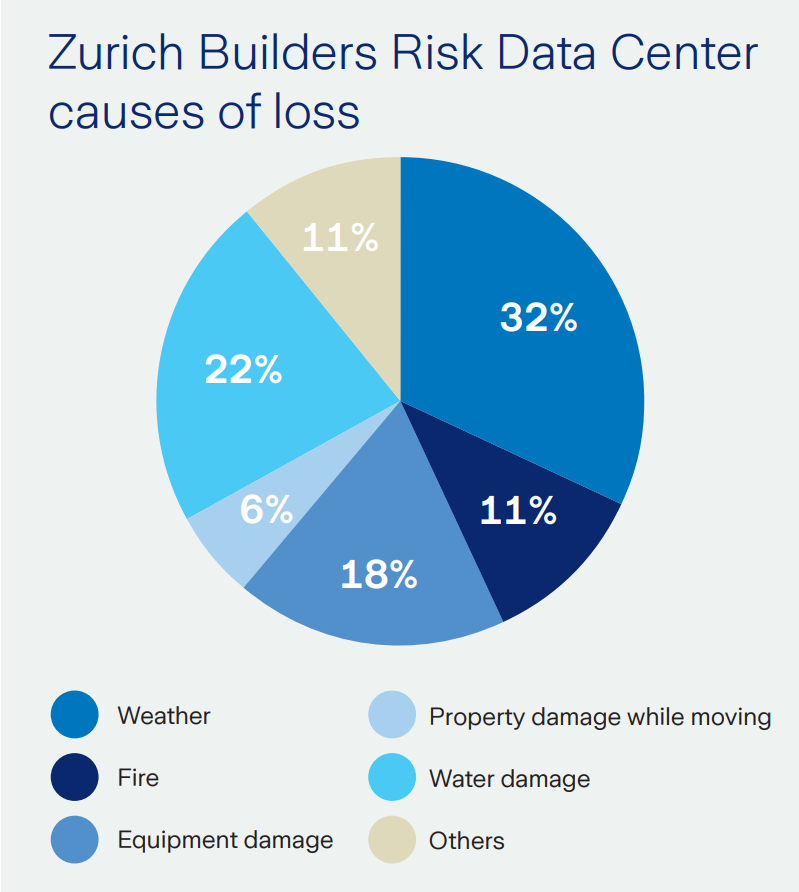
Severe weather has been the leading cause of loss in our data center Builders Risk portfolio for the past three years.
Patrick McBride
Head of International Construction for Zurich
But severe weather is a growing risk no matter where a data center is built.
“Severe weather has been the leading cause of loss in our U.S. data center Builders Risk portfolio for the past three years,” said Patrick McBride, Head of International Construction for Zurich. “Before that it didn’t exist in the top three.”
CLAIMS INSIGHT
Built to beat heat—vulnerable to cold
In one data center under construction, equipment staged in unconditioned spaces was hit with sudden uncharacteristic cold, then fast rewarming—triggering condensation and corrosion (i.e., white rust) on sensitive, critical components. Zurich addressed this risk proactively in its Data Center Project Guard solution.
CLAIMS INSIGHT
Hot work during phased construction
One high-severity loss for a Zurich-insured data center in 2025 involved welding along a roof joist after HVAC systems and sensitive equipment had already been installed but before permanent fire protection was in place. A spark landed on an air filter, igniting a blaze that overwhelmed the fire blankets in use.
Another new risk collision course: Compressed timelines and vast scale are making phased handovers the norm, where construction of one data hall is concurrent with early operations in another on a data center campus.
This reinforces the need for a lifecycle view from the earliest stages of data center planning, which hasn’t necessarily been typical. Construction risk and operational property risk are typically evaluated separately and sequentially.
“With data centers, operational perspectives including plan review need to be brought in early, even at site selection,” said Jon Tate, Head of Core Risk Engineering for Zurich Resilience Solutions. “Otherwise, owners could encounter post-completion surprises with retrofits required for operational property coverage.”
Risk improvement actions are typically less expensive and less disruptive when taken sooner, said Bill Ingram, Vice President of Technical Operations for Zurich Resilience Solutions.
“If a property and machinery breakdown engineer looks at the design upfront, pre-construction, they can say, ‘This is how you can be more insurable after the fact.’ If they see flammable or combustible insulation materials in the plan, they can recommend alternatives,” Ingram said. “It’s about making yourself the most desirable risk you can be to the marketplace.”
Zurich Risk Engineering data suggests owners increasingly recognize this. The number of hours that Zurich risk engineers spend annually on data center reviews increased 500% from 2020 to 2025.
III. How are energy and water constraints being handled with data centers?
Finding options amid a power struggle
Data centers are becoming the grid’s most consequential customers. As demand for data centers grows, annual investments in power generation could reach as high as $200 billion. Clean energy is a large piece of the puzzle. About 67% of energy used in data centers came from renewable sources in 2025, according to the S&P Global Corporate Sustainability Assessment.
Water is another key need, with hyperscale data centers sometimes using it both to cool servers and to generate electricity.
“Major companies increasingly seek dedicated energy and water sources for their data center projects,” said Patrick McBride, Head of International Construction for Zurich. “These are immediate challenges that our customers and prospects are grappling with.”
In the U.S., data center power demand rose roughly 22% in a single year, according to S&P Global. By 2030, demand is projected to nearly triple, reaching approximately 134 GW.
Rising power density doesn’t just strain the grid—it compresses heat into smaller footprints. Cooling at data centers is crucial.
“Water demand for cooling is significant,” said Jeff Castle, Risk Engineering Manager for Machinery Breakdown with Zurich Resilience Solutions. “That can be a challenge in working with the municipality.”
Some data centers integrate closed loop systems to recycle and reuse water, or opt for direct or indirect air cooling. Operators such as Google, Meta and Microsoft track Power Usage Effectiveness (PUE) and Water Usage Effectiveness (WUE) or similar metrics as part of their sustainability and operational reporting (Microsoft, 2025; Google, 2024; Meta Platforms, 2025).
To keep projects moving amid grid constraints, many developers are investing in behind-the-meter energy solutions, including natural gas turbines, battery energy storage systems (BESS) and renewables. An Apple data center in North Carolina uses an array of renewables including solar, wind and biogas, derived from landfill waste.
Historically, onsite power infrastructure was underwritten separately from the data center itself. But this is evolving.
“Onsite power is starting to move from adjacent to integrated in some cases,” said Steve Penwright, Head of Underwriting for U.S. National Accounts, citing one large data center development in Texas where onsite generation, gas turbines and the power plant are treated as part of the overall operational property risk, rather than standalone assets.
Hyperscalers' contracted carbon-free energy capacity
U.S. projects only as of February 2026, in megawatts (MW)
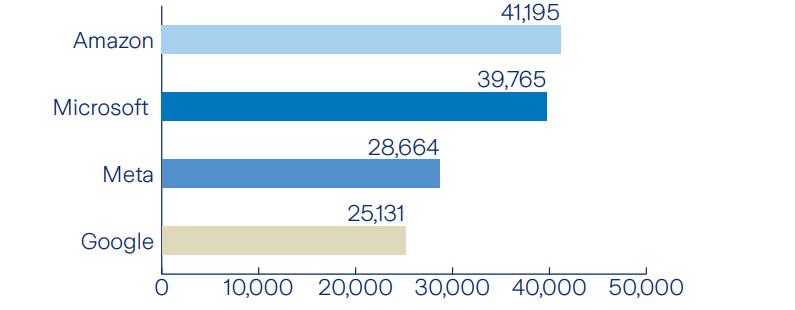
*Analysis does not include most onsite corporate renewable capacity, such as rooftop solar systems. Only includes deals with sufficient details available.
Source: S&P Global Market Intelligence; public reports.
Several hyperscalers have committed to covering the cost of their electricity consumption, including grid improvements. Many are prioritizing cleaner fuels and onsite generation not only to ensure affordability, reliability and resilience but also to support their sustainability goals and energy security amid geopolitical conflicts.
But even this is creating some additional pressures. Lead times for new gas fired turbines have stretched to three years or more in the U.S., accompanied by rising costs, driven by surging demand from data centers and grid scale power projects.
“We used to see data center complexes with four or five 40- to 80-megawatt data center buildings,” said Curt Westrick, Principal Risk Engineer for Zurich Resilience Solutions. “Now we’re seeing campuses with 20+ buildings of this size, or larger 200-plus-megawatt buildings, and even gigawatt-plus campuses. At least two projects we’ve reviewed are 2 gigawatts (2,000 megawatts).”
Nuclear power has drawn considerable attention. Some hyperscalers are contracting with operating nuclear plants or restarting dormant ones. Potential licensure for small module nuclear reactors realistically remains five to 10 years away.
“Sustainable power and water solutions are key challenges to address for the future of data centers,” McBride said. “There will be need for further infrastructure support and innovation.”
Sustainable power and water solutions are key challenges to address for the future of data centers.
Patrick McBride
Head of International Construction for Zurich
IV. Is redundancy built in for data center downtime?
Why “mirroring” matters
We are at a peak moment in the artificial intelligence era, with over $77 billion in U.S. data center construction starts in 2025—an increase of over 190% from prior year—including over $44 billion breaking ground in Q4 alone.
But AI adoption isn’t all that data centers support. Data centers underpin the global economy and daily life. Financial markets, logistics, healthcare, energy and retail rely on uninterrupted computing. A single outage can cascade, disrupting not only direct customers but also supply chains.
In November 2025, for example, a failure of a data center cooling system halted trading on a major global derivatives exchange—locking participants out of Asian markets when seconds matter. The event illustrates how a local outage can ripple instantly into broader impact.
“During the early years of cloud computing, most organizations used single-location data centers. These data centers faced higher risks of downtime because of concentrated disasters,” Penwright said. “So cloud service providers introduced the concept of regions and availability zones. This was a milestone, facilitating high availability through geographic distribution.”
A region is a geographic area with a collection of data centers. Each region operates independently, ensuring that a failure in one region doesn’t affect others. A region typically has multiple availability zones, designed for high availability and low latency connections. An availability zone typically consists of at least three data centers.
Whether they know it or not, every company is in the data center business.
Steve Penwright
Zurich Head of Underwriting for U.S. National Accounts

“The customer decides which availability zones to purchase,” Penwright said. “The more you buy the more expensive. The goal is to have no dependency between the data centers, so if one goes down, the others will pick up that service.”
This is critical. In March of 2026, Iranian drone strikes damaged Amazon Web Services data centers in the UAE and Bahrain, causing regional cloud outages. The company recommended that customers “migrate workloads to alternate AWS Regions,” reflecting a trend the Uptime Institute calls “distributed resiliency.”
Types of data centers
Data centers typically fall into four categories.
- Enterprise – you build, operate and own.
- Managed services – a provider runs it for you.
- Co-location – you rent space and bring your own servers.
- Cloud – an off-premises data center hosted by service providers like Amazon, Microsoft and Google Cloud.
Tiering is based on performance requirements.
- Tier I: Basic, non‑redundant. 28.8 hours of downtime/year
- Tier II: Some redundancy. 22 hours of downtime/year
- Tier III: Concurrently maintainable. 1.6 hours of downtime/year
- Tier IV: Fully redundant & fault‑tolerant. 26 minutes of downtime/year
Source: Uptime Institute Tier Classification System - Uptime Institute
The Uptime Institute credits distributed resiliency for declines in outage frequency: 53% of data‑center operators reported an outage in recent years, down from 78% in 2020, according to Annual Outage Analysis 2025 - Uptime Institute.
A question for all businesses: Do you know where your data center dependencies and redundancies are?
V. What’s the impact of a data center construction delay or operational downtime?
Machinery breakdown and human error can’t be ignored
When data center equipment fails—whether during construction, commissioning or operations—losses escalate fast. The combination of more and higher-value equipment, compressed schedules, onsite power and lag time for replacements leaves little margin for error.
Many contracts may impose stiff penalties for a delay in startup (known as “DSU”) or breaches of a service level agreement (SLA) that cause business interruption. If insurance programs aren’t carefully structured, disputes can ensue over whether such claims are covered by construction or property policies.
“Loss-of-income scenarios on large risks like data centers can be complex with multiple interdependencies driving severity,” said Megan Jameson, Global Head of Underwriting for Zurich Construction. “Phased turnover with tricky DSU to business interruption transitions, campus-style construction, rapid technology shifts and more can affect the likelihood of a total loss and are increasingly important underwriting considerations.”
With projects of such scale, the potential culprits behind a mishap are too numerous to count. But among them:
“When you go from two to 20 transformers on a site, and 10 to 100 HVAC units, the probability for equipment failure or human error to impact one of those is exponentially higher,” said Vinny Dominguez, Senior Risk Engineering Consultant for Zurich Resilience Solutions. “This can greatly elevate the risk of DSU and SLA losses.”
Lithium-ion batteries used to be quarantined away from servers; increasingly they’re embedded into server racks within data center halls. This greatly changes the risk profile, said Mike Widdekind, Global Property Practice Leader for Zurich Resilience Solutions.
“From a business interruption standpoint, even if it’s a small fire event, the operator may have to shut down the cooling system. Then the heat goes up. The smoke doesn’t have to get to the equipment. The heat and the humidity may end up doing it in,” Widdekind said.
The cost of downtime
Downtime costs accumulate fast. The Uptime Institute estimates:
- 16% of recent outages exceeded $1 million total impact
- Power and cooling failures are the leading causes, intensified by AI density
For a 100 MW AI data center, the initial construction cost (land, building, power and cooling infrastructure) may range from around $900 million to $1.5 billion. Servers, networking gear and thousands of AI chips, known as Graphics Processing Units (GPUs), can add about $2.5 billion or more. In other words, the IT equipment often represents the single largest expense. If that equipment fails, replacement lead times and cost often exceed expectations.
“This typically isn’t off-the-shelf equipment, and many times it’s manufactured outside the U.S.,” said Jimmy Johnson, Vice President of Commercial Property Claims. “Sometimes manufacturers can move orders around and reallocate equipment scheduled for another project, but it can be logistically complicated.”
Replacement time estimates, according to the Turner Construction Facility Equipment Cost Index
- UPS systems: ~30–52 weeks
- Switchgear: ~65–85 weeks
- Generators: ~45–100 weeks
- Lighting controls (lower complexity electrical gear): ~16–20 weeks
Source: https://www.turnerconstruction.com/uploads/23q1-facilities-cost-index-sourceblue.pdf
Not all fires are small. "Lithium-ion battery fires are exceptionally challenging," said Bob Woodard, Property Fire Protection Director for Zurich Resilience Solutions. "These create a chemical reaction that turns into what's called thermal runaway, which are fires that release very high heat and a lot of smoke and burn for much longer."
Kyle Neuman, Technical Director for Property with Zurich Resilience Solutions, adds that diligent maintenance and regular inspections are critical for onsite power resources such as turbines.
"Variability in demand for AI computing can be hard on what we call 'peaking units,' where they ramp up quickly to provide energy when needed and then shut down once the demand subsides," he said. "AI demands can swing 100 megawatts in seconds. Each start/stop cycle causes wear and tear."
Labor is a key input
The critical supply chain includes skilled labor. The shortage of electricians has been called "dire" on one hand, but presents career opportunities on the other.
Demand for construction workers
92%
of U.S. construction firms are having difficulty finding qualified workers
Associated General Contractors of America
349,000
Estimate of net new workers needed in 2026 to meet construction demand
As labor shortages intensify, less skilled and experienced labor may be enlisted, or crews may work extended hours, leading to fatigue. This can escalate risk of human error, particularly around highly energized electrical equipment. Dust or other contact can trigger arc flash incidents that can cause a small fire or even an explosion.
One near-miss involved crews cleaning fan systems that appeared to be off but could be activated by humidity or other conditions. “They were unaware that those might trip on at any moment and cause injury,” said Tom Flannagan, Construction Regional Field Team Leader for Zurich Resilience Solutions. “These environments need very tight controls.”
Data center crews can earn around $40 per hour compared to the construction industry average around $30. Working conditions in some cases are being enhanced with climate-controlled restrooms and more comfortable break areas. One hyperscaler has added onsite health clinics with physical therapists to support workers, said James Savage, U.S. Head of Construction Casualty for Zurich.
“Given the highly technical nature of the work and the demand for skilled labor, employers are investing heavily in both job site amenities and the safety resources workers have access to,” Savage said. “By investing in top-tier talent, contractors have been able to retain crews who have worked on multiple data centers together and ultimately deliver more consistent results.”
VI. Can today’s data centers adapt for tomorrow?
How regulatory, technological and geopolitical dynamics could intervene
The U.S. remains the global epicenter of data center development, accounting for roughly 40-45% of global capacity, followed by China and the European Union. But technological advancements and other dynamics surrounding growth are evolving fast. Will today’s data centers still work under tomorrow’s rules and realities?
Predicting the future is fraught with peril. But here’s a look at a few trends that could shape it.
Community and legislative concerns
Consumers and legislators are scrutinizing local impacts on energy prices and water use as well as noise and land use relative to durable job creation. Many U.S. legislators generally value economic development fueled by data center construction, particularly in areas that have suffered disinvestment.
“But many U.S. states are exploring ways to shore up consumer protections, especially from rising electricity costs as data centers strain the grid,” said Deirdre Manna, U.S. Head of Government and Regulatory Relations for Zurich. “Proposals include creating special rate categories for large load users or moratoriums on new data center construction until certain conditions are met.”
Geopolitics and the next wave of growth
The U.S. Congress enacted the Federal Data Center Enhancement Act as part of the FY2024 National Defense Authorization Act (NDAA), addressing agency data center resilience, security and commercial flexibility. In an increasingly charged geopolitical environment, other countries similarly view digital infrastructure as a matter of national security.
While many want to expand local data center infrastructure, they face the same complexities as the U.S., sometimes intensified, whether land, energy or sustainability constraints. Brazil is emerging as a major destination for data center investment in part because its electricity grid is among the cleanest in the world, with roughly 85–90% of power generated from renewable and low-carbon sources, led by hydropower. This has made Brazil attractive to hyperscalers and operators with decarbonization goals.

Nuclear, quantum and other more distant prospects, such as space-based centers:
Elon Musk and Jeff Bezos have proposed porting data centers into the final frontier — space, to bypass terrestrial constraints on acreage, power and cooling. Both SpaceX and Blue Origin have filed applications with the Federal Communications Commission for orbital data center constellations, citing plentiful power from solar energy and cooling through radiative heat dissipation.
Nuclear energy is emerging as a serious option for reliable, carbon-free baseload power. Hyperscalers are signing long-term power purchase agreements with existing nuclear plants and exploring development of small modular reactors (SMRs), which would likely deliver 300 megawatts or less and offer more flexible siting than traditional reactors. Projects linking data centers directly to large nuclear facilities include Amazon Web Services’ campus tied to the Susquehanna nuclear plant and Microsoft’s tied to the Three Mile Island plant, both in Pennsylvania. Regulations, manufacturing and insurance considerations may limit near-term deployment of SMRs, but they are increasingly viewed as viable within five to 10 years.
Investments in quantum computing could drive advancements in data centers, with hubs for quantum development emerging in Chicago, Boston and other cities. Some hyperscalers are anticipating how they might accommodate quantum processors alongside CPUs and GPUs.
In conclusion
Overall, the rapid pace of change puts a strong premium on adaptability and diversification in the data center buildout. Stakeholders are keenly aware that today’s environment could shift tomorrow.
Zurich is a leading insurer of data center construction as part of a larger, diversified portfolio and remains a carrier of choice for construction projects of many types.
“With deep insights and expertise, we’re well-positioned to support innovation and continued development in digital infrastructure, including outside the U.S.,” said Sierra Signorelli, U.S. CEO and Global Commercial Insurance CEO for Zurich. “Zurich’s capabilities span over 200 countries and territories, and our disciplined approach is validated by our 154 years of longevity and leadership in risk management.”
Zurich offers a number of solutions including but not limited to construction, surety, energy, property, casualty, liability, cyber, multinational that help all stakeholders balance opportunity and innovation with protection and sustainability.

The information in this publication was compiled from sources believed to be reliable for informational purposes only. All sample policies and procedures herein should serve as a guideline, which you can use to create your own policies and procedures. We trust that you will customize these samples to reflect your own operations and believe that these samples may serve as a helpful platform for this endeavor. Any and all information contained herein is not intended to constitute advice (particularly not legal advice). Accordingly, persons requiring advice should consult independent advisors when developing programs and policies. We do not guarantee the accuracy of this information or any results and further assume no liability in connection with this publication and sample policies and procedures, including any information, methods or safety suggestions contained herein. We undertake no obligation to publicly update or revise any of this information, whether to reflect new information, future developments, events or circumstances or otherwise. Moreover, Zurich reminds you that this cannot be assumed to contain every acceptable safety and compliance procedure or that additional procedures might not be appropriate under the circumstances. The subject matter of this publication is not tied to any specific insurance product nor will adopting these policies and procedures ensure coverage under any insurance policy. Nor should any description of a claim or loss scenario in this publication be construed as a guarantee of insurance coverage for same, which would be dependent on the facts and circumstances of any particular claim or loss and the terms and conditions of the insurance product at issue. Insurance coverages are underwritten by individual member companies of Zurich in North America, including Zurich American Insurance Company. Certain coverages are not available in all states. Some coverages may be written on a nonadmitted basis through licensed surplus lines brokers. Risk engineering services are provided by The Zurich Services Corporation.
©2026 Zurich American Insurance Company. All rights reserved. A1-P1205294-A (04/26) P1205294
REFERENCES
Intro / This is not last year’s data center
- Austin Energy. (2024). 2024 annual report. https://austinenergy.com/-/media/project/websites/austinenergy/about/pdfs/2024_annual_report.pdf
- JLL. (2026). 2026 global data center outlook. https://www.jll.com/en-us/insights/market-outlook/data-center-outlook
- New York Independent System Operator, Inc. (2025). Load & capacity data report (Gold Book). Table I 3a. https://www.nyiso.com/documents/20142/2226333/2025-Gold-Book-Public.pdf
- McKinsey & Company. (2024). The cost of compute power: A $7 trillion race to scale data centers. https://www.mckinsey.com/industries/technology-media-and-telecommunications/our-insights/the-cost-of-compute-a-7-trillion-dollar-race-to-scale-data-centers
- New York Independent System Operator. (n.d.). Power trends. https://www.nyiso.com/power-trends
Question 1: How much insurance is enough?
- Roach, A. (2026, April 6.) AI data center boom ‘stress tests’ insurers as private capital floods in. CNBC. https://www.cnbc.com/2026/04/06/ai-data-centers-financing-insurance-deals-gpu-debt.html.
Question 2: Are we adjusting for new intersections of risk?
- Swiss Re Institute. (2026). Wildfires, storms, floods contribute to record global insured losses. https://www.swissre.com/press-release/Wildfires-storms-floods-contribute-to-record-92-of-global-insured-losses-in-2025-says-Swiss-Re-Institute/7b39b1a5-b878-4a55-a5ff-bf5aa561a675
- JLL. (2026). North America data center report: Year-end 2025. https://www.jll.com/en-us/newsroom/jll-north-america-data-center-report-year-end-2025
Question 3: How are energy and water constraints being handled?
- Goldman Sachs. (2024, April 29). Generational growth: AI, data centers and the coming U.S. power demand surge. https://www.goldmansachs.com/insights/goldman-sachs-research/generational-growth-ai-data-centers-and-the-coming-us-power-demand-surge
- Lenoir, T., & Wilson, A. (2026, April 7). Whether you call it “sustainability” or “energy autonomy,” AI needs solar and wind. S&P Global. https://www.spglobal.com/en/research-insights/special-reports/ai-needs-solar-wind-sustainability-energy-autonomy
- Hendershot, S. (2026, March 23). AI data center boom drives surge in Great Lakes water use. Crain’s Chicago Business. https://www.chicagobusiness.com/forum/ccb-forum-midwest-water-data-centers-great-lakes-20260323/
- Skidmore, Z. (2025, October 15). S&P Global: U.S. data centers to require 22% more grid-based power by end of 2025. Datacenter Dynamics. https://www.datacenterdynamics.com/en/news/sp-global-us-data-centers-to-require-22-more-grid-based-power-by-end-of-2025/
- Hering, G., & Dlin, S. (2025, October 14). Data center grid–power demand to rise 22% in 2025, nearly triple by 2030. S&P Global. https://www.spglobal.com/energy/en/news-research/latest-news/electric-power/101425-data-center-grid-power-demand-to-rise-22-in-2025-nearly-triple-by-2030
- Tozzi, C. (2025, January 17). A guide to data center water usage effectiveness (WUE) and best practices. Data Center Knowledge. https://www.datacenterknowledge.com/cooling/a-guide-to-data-center-water-usage-effectiveness-wue-and-best-practices
- Lindenmuth, D. (2025, August 1). How biogas is solving data centers’ clean energy challenge. POWER Magazine. https://www.powermag.com/how-biogas-is-solving-data-centers-clean-energy-challenge/
- Google. (2024). Advancing responsible water use at our data centers. https://datacenters.google/water/
- Meta Platforms, Inc. (2025). Environmental Data Index 2025. https://sustainability.atmeta.com/wp-content/uploads/2025/10/Meta_2025-Environmental-Data-Index.pdf
- Microsoft. (2025). Measuring data center energy and water efficiency. https://datacenters.microsoft.com/sustainability/efficiency/
- Butler, G. (2025, April 7). Apple to invest $175m in expanding North Carolina data center. Datacenter Dynamics. https://www.datacenterdynamics.com/en/news/apple-to-invest-175m-in-expanding-north-carolina-data-center/
- Fernholz, T. (2026, February 25). The White House wants AI companies to cover rate hikes — most have already said they would. TechCrunch. https://techcrunch.com/2026/02/25/the-white-house-wants-ai-companies-to-cover-rate-hikes-most-have-already-said-they-would/
- Anderson, J. (2025, May 20). U.S. gas-fired turbine wait times stretch to seven years as costs rise. S&P Global. https://www.spglobal.com/energy/en/news-research/latest-news/electric-power/052025-us-gas-fired-turbine-wait-times-as-much-as-seven-years-costs-up-sharply
Question 4: Is redundancy built in for data center downtime?
- Guckes, M. (2026, January 27). U.S. data center construction starts continue to surge. ConstructConnect. https://news.constructconnect.com/data-center-starts-continue-to-blow-past-expectations
- Taylor, C. (2025, November 28). Stock futures resume trading after a halt caused by ‘cooling issue’ at data center. CNBC. https://www.cnbc.com/2025/11/28/cme-halts-fx-commodities-futures-trading-after-data-center-issue.html
- Nicol-Schwarz, K., & Graham, E. (2026, March 3). Banking, payments services disrupted after Amazon UAE data centers hit in drone strikes. CNBC. https://www.cnbc.com/2026/03/03/iran-war-uae-drone-strikes-aws-data-centers.html
- Uptime Institute. (n.d.). Tier classification system. https://uptimeinstitute.com/tiers
- Uptime Institute. (2025). Annual outage analysis 2025. https://uptimeinstitute.com/resources/research-and-reports/annual-outage-analysis-2025
Question 5: What’s the impact of a data center construction delay or operational downtime?
- Uptime Institute. (2024). Resiliency survey executive summary. https://datacenter.uptimeinstitute.com/rs/711-RIA-145/images/2024.Resiliency.Survey.ExecSum.pdf
- Vila, D. (2025). Deconstructing the data center: A look at the cost structure. Alpha-Matica. https://www.alphamatica.com/post/deconstructing-the-data-center-a-look-at-the-cost-structure-1
- Turner Construction Company. (2023). Facility equipment cost index. https://www.turnerconstruction.com/uploads/23q1-facilities-cost-index-sourceblue.pdf
- Fore, P. (2026, March 2). A dire electrician shortage is a “life or death” threat to the AI data center boom—and an opportunity for Gen Z. Fortune. https://fortune.com/2026/03/02/ai-data-centers-electrician-shortage-gen-z-training-careers/ and https://finance.yahoo.com/news/dire-electrician-shortage-life-death-080000954.html?guccounter=1
- Associated General Contractors of America. (2025, August 28). Construction workforce shortages are leading cause of project delays as immigration enforcement affects nearly one third of firms. https://www.agc.org/news/2025/08/28/construction-workforce-shortages-are-leading-cause-project-delays-immigration-enforcement-affects
- Associated Builders and Contractors. (2026, January 15). Construction industry must attract 349,000 workers in 2026 despite macroeconomic headwinds. https://www.abc.org/News-Media/News-Releases/abc-construction-industry-must-attract-349000-workers-in-2026
- Construction Owners. (2025). Data center boom sends construction pay surging. https://www.constructionowners.com/news/data-center-boom-sends-construction-pay-surging
- Chen, T.-P. (2025, November 29). Data centers are a “gold rush” for construction workers. The Wall Street Journal. https://www.wsj.com/business/data-centers-are-a-gold-rush-for-construction-workers-6e3c5ce0
Question 6: Can today’s data centers adapt for tomorrow?
- Neufeld, D. (2024). Data center capacity around the world. Visual Capitalist. https://www.visualcapitalist.com/data-center-capacity-around-the-world/
- Goetzel, D., Muro, M., & Methkupally, S. (2024). Turning the data center boom into long-term local prosperity. Brookings Institution. https://www.brookings.edu/articles/turning-the-data-center-boom-into-long-term-local-prosperity/
- International Energy Agency. (2025). Brazil 2025: Executive summary. https://www.iea.org/reports/brazil-2025/executive-summary
- Ma, J. (2026, March 20). Bezos backed Blue Origin files for approval to put data centers in space. Datacenter Dynamics. https://www.datacenterdynamics.com/en/news/bezos-backed-blue-origin-files-for-approval-to-put-data-centers-in-space/
- Boyle, A. (2026, March 21). Blue Origin jumps into the orbital data center race with Project Sunrise. GeekWire. https://www.geekwire.com/2026/blue-origin-data-center-space-race-project-sunrise/
- U.S. Energy Information Administration. (2024). Data center owners turn to nuclear as potential electricity source. https://www.energy.gov/sites/default/files/2024-12/44-%20Exh.%20PP%20-Data%20center%20owners%20turn%20to%20nuclear%20as%20potential%20electricity%20source%20%28EIA%29.pdf
- Howland, E. (2024). Talen, Amazon link AWS data center campus to Susquehanna nuclear plant. Utility Dive. https://www.utilitydive.com/news/talen-amazon-aws-susquehanna-nuclear-data-center-t/750440/
- Brown, E., & Morgan, K. (2025). Disrupting the future: Quantum in data centers? S&P Global. https://www.spglobal.com/en/research-insights/special-reports/look-forward/data-center-frontiers/quantum-data-centers-disrupting-future