
Supplemental Gap Medical Insurance
Why choose Zurich for Supplemental Gap Medical Insurance?
The strength of Zurich American Insurance Company's (Zurich) Supplemental Gap Medical Insurance goes far beyond policy details. We offer a dedicated support team for coordination of plan development, marketing, administration onboarding, and program management. We provide you with a single point of contact, as well as administration that details processes, forms, and group/individual contact information. Zurich underwriters work closely with employers and brokers to understand organizational needs, customize group-priced benefit solutions, and simplify ongoing plan administration. We’ll work with you to help simplify the administration of your program and we’re always ready to answer questions to help address your needs and those of your employees.
At Zurich, our customers' needs remain the heart of everything we do.
Build confidence in your benefits
A well-structured benefits program supports workforce stability and financial preparedness. As healthcare cost-sharing structures evolve, employees may face greater financial variability. Offering structured supplemental insurance solutions can be an effective component to demonstrate a commitment to their financial well-being. It shows you understand the pressures they face outside of the workplace.
By helping address gaps left by high-deductible health plans, you provide additional financial support within your overall benefits structure. This foresight helps build a culture of confidence and care, allowing your team to focus on a brighter future. Offering structured supplemental insurance coverage supports a well-rounded benefits strategy. Zurich works with you to provide flexible options designed to strengthen your overall benefits strategy and help your business and your people prepare for what’s next.
Supporting workforce recruitment and retention
Supplemental Gap Medical Insurance can help employers strengthen their overall benefits offering while supporting workforce recruitment and retention efforts. By helping employees manage medical expenses associated with high-deductible health plans, employers may be able to offer meaningful financial protection while maintaining a competitive benefits package.
Related insurance offerings
Supplemental Gap Medical Insurance can work alongside other Zurich Accident & Health insurance solutions to create a more supportive employee benefits offering.

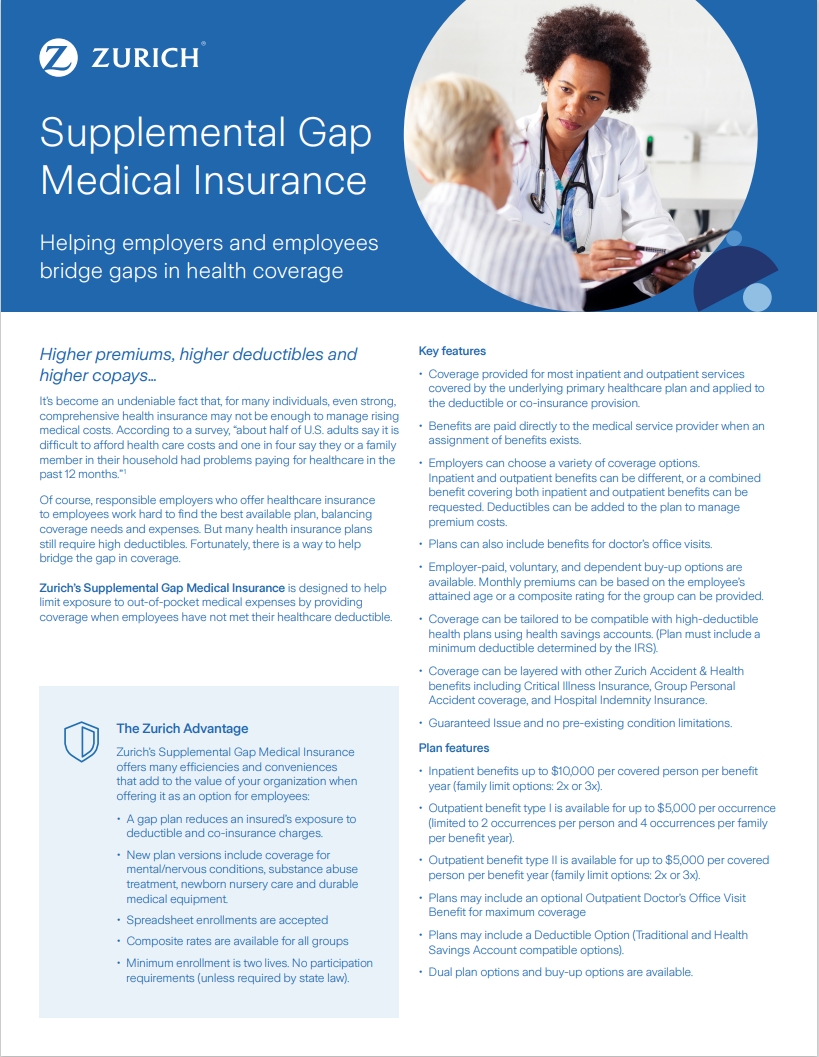
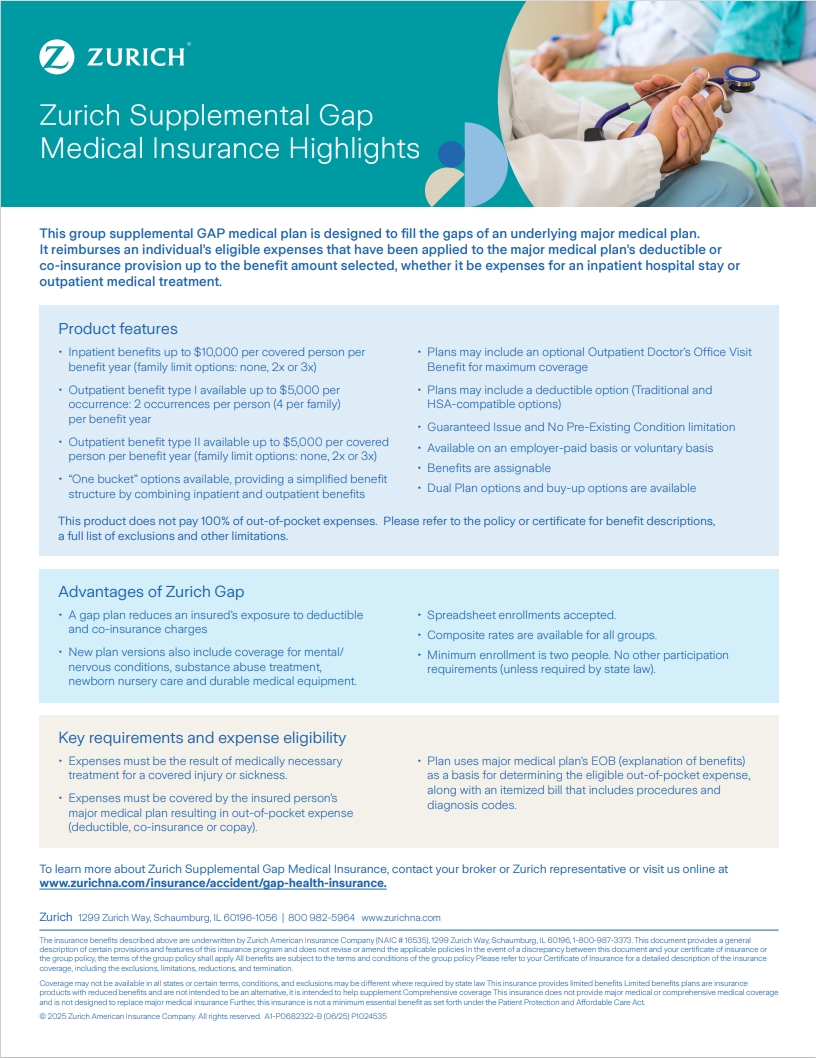
Supplemental Gap Medical Insurance options
Our supplemental gap medical insurance plans are flexible and can be customized to meet the specific needs of each employer group. We have the capability to work within a wide range of benefits administration platforms, whether managed by a broker or vendor. Our Underwriters can customize group-priced benefit solutions for your organization.
Employers can select from a variety of coverage structures, including separate inpatient and outpatient benefits or combined benefit designs that address both types of medical expenses. Plan deductibles may also be incorporated to help manage premium costs while supporting overall benefits objectives.
Inpatient and outpatient medical expense coverage
Supplemental Gap Medical Insurance helps cover eligible out-of-pocket costs, such as deductibles and coinsurance, associated with covered inpatient and outpatient medical services under an employee's primary health plan.
Flexible benefit design
Tailored coverage designs may include benefits for eligible doctor office visits in addition to inpatient and outpatient medical expenses. Zurich works to develop benefit structures that align with workforce needs and benefits strategies.
See Gap coverage in action
Understanding how insurance products function is key to appreciating their value. Supplemental Gap Medical Insurance is designed to be straightforward. It works alongside an employee’s primary high-deductible health plan to help manage out-of-pocket expenses.
Consider this common scenario: An employee has a covered hospital stay. Their primary health plan has a $5,000 deductible, meaning they are responsible for that amount before their main coverage begins paying. After the primary insurance pays its portion, subject to policy terms, the Gap Medical Insurance policy may provide a cash benefit to help address eligible deductible and out-of-pocket expenses. This additional layer of coverage can align with your overall benefits strategy.

Want to learn more?
Connect with our Customer Inquiry Center for more information.
FAQs
Many employers offer Supplemental Gap Medical Insurance to help employees manage out-of-pocket expenses associated with high-deductible health plans. The coverage can help strengthen an overall benefits package, support employee financial well-being and contribute to recruitment and retention efforts by providing additional financial protection when medical care is needed.
Yes. Supplemental Gap Medical Insurance can be configured to work with many high-deductible health plans. Certain plan designs may also be compatible with health savings account (HSA) arrangements, although compatibility depends on the specific plan configuration. Employers should review their benefits strategy with their broker or Zurich representative to determine the appropriate structure.
Plan designs can be customized to meet the needs of an employer group. Options may include different inpatient and outpatient benefit structures, combined benefit designs, deductible options and additional benefits such as eligible doctor office visit coverage. Employers can work with Zurich to tailor coverage to their workforce and budget objectives.
Zurich provides dedicated support throughout plan development, onboarding, administration and ongoing program management. We can also work with a broad range of benefits administration platforms managed by employers, brokers or third-party vendors.
Yes. Supplemental Gap Medical Insurance can complement other Zurich Accident & Health Insurance solutions, including Critical Illness Insurance, Group Personal Accident Insurance coverage and Hospital Indemnity Insurance, helping employers create a more supportive benefits strategy.
Yes. Supplemental Gap Medical Insurance may be offered as employer-paid, voluntary or hybrid coverage depending on organizational objectives. Dependent coverage and buy-up options may also be available. Premium structures can be designed using attained-age or composite rating methodologies.
Supplemental Gap Medical Insurance may help address eligible out-of-pocket healthcare expenses associated with covered inpatient and outpatient services under an employee's primary health plan. Benefits may help offset deductible and coinsurance obligations, helping employees better manage healthcare costs.
Supplemental Gap Medical Insurance helps individuals manage out-of-pocket medical expenses. It is designed to help limit exposure to out-of-pocket medical expenses when the primary health insurance deductible has not been met. Supplemental Gap Medical Insurance must be used in conjunction with a major medical insurance plan; it cannot be used as a stand-alone product.
- Benefits are paid directly to the medical service provider. Claim forms are not necessary in most cases when an assignment of benefits exists.
- Employers can choose a variety of coverage options, including varied inpatient and outpatient benefits. Deductibles can be added to the plan to manage premium costs.
- For employer-paid, voluntary, and dependent buy-up options, monthly premiums can be based on the employee’s attained age or a composite rating for the group can be provided.
- Coverage can be configured to be compatible with high-deductible health plans using health savings accounts.*
*Some product configurations may not be compatible with high-deductible health plans involving a tax-advantaged health savings account (HSA).